

A subtitle is a translation with a deadline
Every subtitle lives inside a box. Viewers have to read it in the time the shot allows, so broadcasters and platforms enforce hard limits: a maximum number of characters per line, a maximum number of lines, and a reading speed measured in characters per second. The exact figures vary by client and by language, but they are never optional. A subtitle that breaks them is flagged at QC and sent back, however elegant the wording.
That is what makes subtitling different from every other kind of translation. A translation can be accurate, fluent and idiomatic and still be a failed subtitle, simply because it is too long for the seconds it is on screen, or in the wrong place, or simply timed incorrectly (or as we find out in live production, not so simply!).
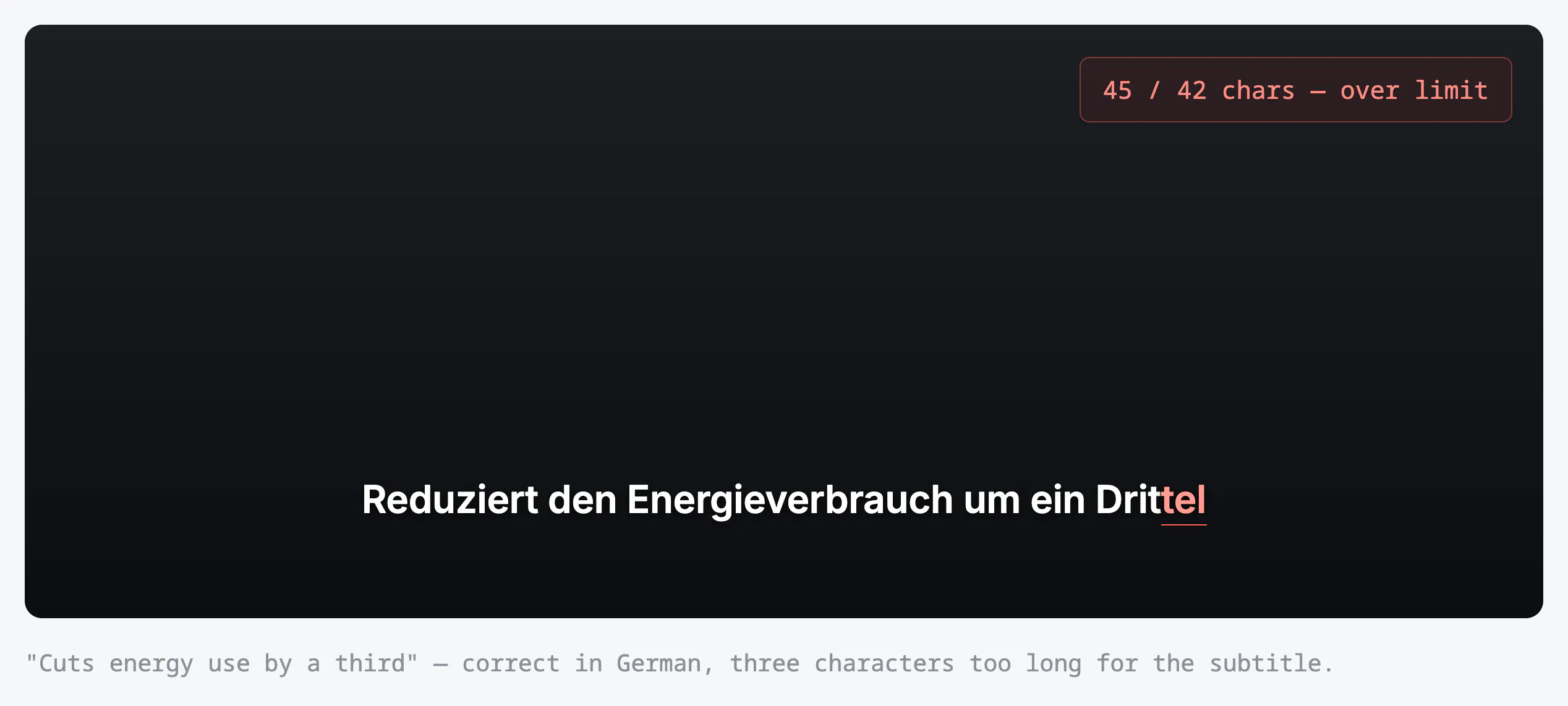
The problem, in numbers
Machine translation engines translate text. They know nothing about your timeline, your character limits, or your reading-speed profile, and translations expand. German runs long. French runs long. Dense scripts such as Chinese and Japanese carry their own, tighter limits, where a handful of extra characters is a much larger share of the budget.
We have been measuring this continuously on real production translations since May 2025. Across that period, state-of-the-art MT engines returned text that violated the length requirements of roughly 1 in 10 for European languages, and about 1 in 12 for Chinese, Japanese, Korean, Arabic, Hebrew and Hindi.
e.g. on a 2,000-caption project, that is a couple of hundred captions a linguist has to shorten by hand before the file will pass QC, every project, every language.
Captions failing length requirements - European languages
Monthly average, % of translated captions, May 2025 - July 2026
View data table
| Raw MT output | After CaptionHub post-processing | |
|---|---|---|
| May 2025 | 10.2% | 9.6% |
| Jun 2025 | 9.8% | 8.9% |
| Jul 2025 | 10.4% | 7.6% |
| Aug 2025 | 10.1% | 5.9% |
| Sep 2025 | 9.7% | 4.8% |
| Oct 2025 | 10.3% | 4.3% |
| Nov 2025 | 10.0% | 4.1% |
| Dec 2025 | 9.9% | 4.0% |
| Jan 2026 | 10.5% | 4.2% |
| Feb 2026 | 10.2% | 3.9% |
| Mar 2026 | 9.8% | 4.0% |
| Apr 2026 | 10.1% | 4.1% |
| May 2026 | 10.4% | 3.8% |
| Jun 2026 | 10.0% | 3.9% |
| Jul 2026 | 10.2% | 1.8% |
Captions failing length requirements - Chinese, Japanese, Korean, Arabic, Hebrew & Hindi
Monthly average, % of translated captions, May 2025 - July 2026
View data table
| Raw MT output | After CaptionHub post-processing | |
|---|---|---|
| May 2025 | 8.1% | 7.6% |
| Jun 2025 | 7.9% | 6.9% |
| Jul 2025 | 8.3% | 5.4% |
| Aug 2025 | 8.0% | 3.8% |
| Sep 2025 | 7.8% | 2.9% |
| Oct 2025 | 8.2% | 2.4% |
| Nov 2025 | 8.0% | 2.2% |
| Dec 2025 | 8.1% | 2.1% |
| Jan 2026 | 7.7% | 2.0% |
| Feb 2026 | 8.2% | 2.2% |
| Mar 2026 | 8.0% | 1.9% |
| Apr 2026 | 7.9% | 2.0% |
| May 2026 | 8.3% | 2.1% |
| Jun 2026 | 8.1% | 2.0% |
| Jul 2026 | 8.0% | 0.9% |
What CaptionHub delivers instead
CaptionHub will never just hand you the model's output.
Every translation passes through our time-aware and length-aware pipeline before it reaches your team. In fact we run a huge amount of sophisticated processing that we've developed over the past ten years. We then measure the result of that post-processing on the same production data, month after month.
Two waves of improvement are visible in the charts below: a first through 2025, and a further step we shipped in July 2026.
European languages
< 2%
of captions still exceed length limits after CaptionHub
vs ~10% from raw MT
Chinese, Japanese, Korean, Arabic, Hebrew & Hindi
< 1%
of captions still exceed length limits after CaptionHub
vs ~8% from raw MT
Two things are worth reading off those charts.
(1) The raw engines aren't getting better at this on their own: the orange line has been essentially flat for fifteen months. Fitting translations into caption constraints is not something MT providers optimise for, and waiting for them to solve it is not a strategy that any of our customers choose to adopt.
(2) the gap between the two lines is the work CaptionHub does for you on every single project, silently, before a linguist ever opens the file.
The other problem: captions that drift out of step
Length is not the only way raw MT output falls short of the screen. A subtitle file is not just text: it is text cut into captions, each cued to a stretch of the timeline.
When that file is translated, every translated caption should carry the same content as the source caption it replaces, so that what the viewer reads matches what is being said, and shown, at that moment. MT engines often fail to respect those boundaries: given a sequence of captions, they let content slide across the breaks, so a sentence that ended in caption twelve of the source now ends in caption thirteen of the translation. The words are right but they are in the wrong box, at the wrong time which is really important and for anyone that uses captions as part of their viewing experience, it's a massive quality erosion. At best mildly jarring, at worst, it looks completely amateur.
For a localisation team, a drifted caption is as expensive as an overlong one. It no longer matches the shot it sits on, its timing and reading speed are thrown off, and a reviewer comparing source and target side by side can no longer trust that row twelve corresponds to row twelve. Putting it right means manual re-cueing, and files that skip that step fail client QC just like ones that break a character limit.
Measured on the same production data, leading MT engines return on average around 95% of captions correctly aligned with the source, dipping to 93% depending on the engine.
That sounds respectable until you translate it into work: on a 2,000-caption project it is a hundred or more captions in the wrong place. Imagine watching your favourite current season, every few seconds there's a new caption, and then 1 in 10 of those is either completely mis-timed, the words for the previous or next scene, or just not accurate at all. The viewing experience becomes about the captions rather than the magic of story in the content.
After CaptionHub's automatic fixes, 99.9% of captions are aligned: on that same project, a couple of captions rather than a hundred. Which means your linguists have far, far less to change - or you have less risk to absorb if you want to deliver subtitles purely automatically without any linguist intervention.
What this means for your team
For a localisation manager, the difference is concrete. On that same 2,000-caption project, raw MT leaves around 200 overlong captions per European language; CaptionHub leaves fewer than 40, and for Chinese, Japanese, Korean, Arabic, Hebrew and Hindi fewer than 20. The hundred-odd drifted captions raw MT would leave are down to a couple. Reviewers spend their time on meaning and tone rather than trimming characters and re-cueing lines, turnaround shrinks, and files pass client QC first time instead of bouncing back with a warning report.
Length and alignment are not the glamorous parts of machine translation. But they are the parts that decide whether MT output is usable as a subtitle at all, and they are where a subtitling platform earns its keep over a raw engine.
See CaptionHub in action
Get a personalised walkthrough of captioning, translation and voiceover at enterprise scale.


